
One size doesn’t fit all - the issue with school uniform
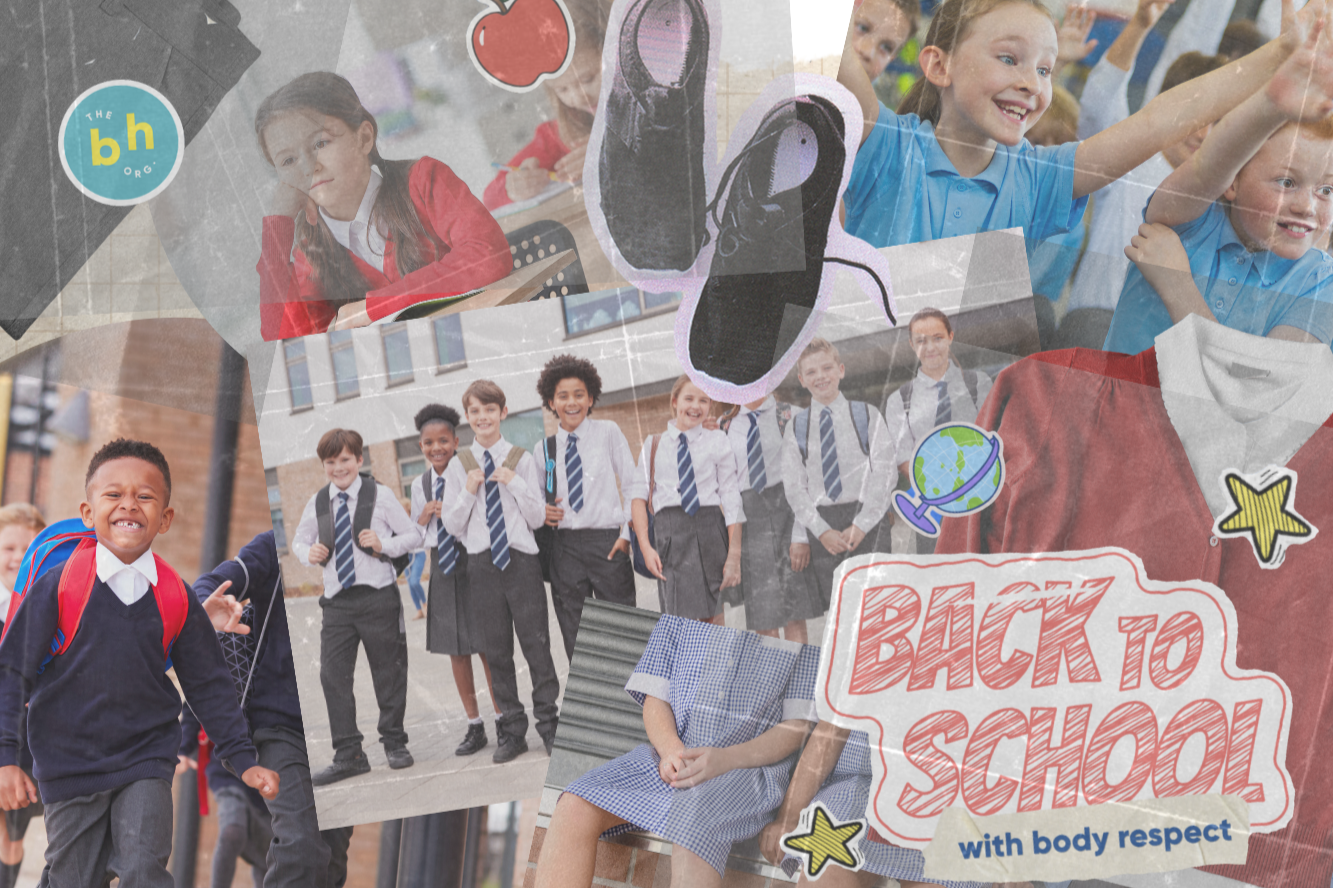
It’s that time of year, when school uniform is everywhere - you can’t avoid it. Shop windows, ads, discounts and school WhatsApp chats are all screaming the same thing - this is what you need to buy and you need to buy it here and NOW! But are we missing something when we do the dreaded back to school shop? Are you thinking about body respect?
We’re told about all the positives that come with kids wearing uniform to school: it’s an equaliser, it helps create a shared identity and build a sense of belonging. But is that really true for all? For some maybe but for others unfortunately not - at worst, a school uniform can promote unhelpful and outdated stereotypes, highlight inequality and make those who already feel uncomfortable in their bodies even worse.
What’s the problem with uniform?
Gender stereotyping is everywhere in the clothing industry and uniform is no different. Girls’ designs tend to be smaller and more fitted than boys’ and can even be made in less durable fabric. This perpetuates the age-old belief that girls bodies are for being looked at and boys’ are for doing.
There are problems around size inclusivity. All clothes for children tend to be classified by age, rather than size, which encourages comparison and the dangerous idea that everyone of a certain age should have the same sized body. Something that is fundamentally untrue. Some uniform providers don’t even cater for bodies of all shapes and sizes.
Although uniform is designed to create equality, it can do the opposite. Not everyone can afford to buy everything new - especially at secondary school, where there are often expensive blazers to buy and multiple kits to think about. If there are no second-hand options, children have to go without.
And then there’s the issue of SEND inclusion. Some children and young people with additional needs struggle with the feeling of clothes being too loose, too tight or too scratchy. If they don’t feel comfortable in their clothes, they will not feel comfortable in their body.
Indeed this is true for any child. And if they don’t feel good, they won’t be able to engage fully at school. And there’s plenty of evidence to prove it - multiple studies show that clothes that make us aware of our bodies can affect how we perform on tasks and how we feel about our bodies. Sportswear brand ASICS found that 70% of 14- to 16-year-old girls surveyed said they would be more likely to participate in school PE lessons if their kit was more comfortable.
What can we do?
Ultimately the power to change uniform policy sits with the school. So if you are an educator who can affect that sort of change, please think about it. At one of the schools from our Body Happy Schools programme pilots, the leadership team consulted with students on uniform and were able to put changes in place. It was one of many improvements that were transformational for both students and teachers.
Whether you are a teacher thinking about policy or a parent buying new uniform, the most important thing to remember is it’s the clothes’ job to fit your body, not your body’s job to fit the clothes. As Body Happy Org founder Molly Forbes says in her book Body Happy Kids, “There is no one-size-fits-all approach to clothing and kids. We do know, though, how clothes fit can impact how we feel in our bodies, and that gender stereotypes can be bad news for body image too.”
In Molly’s book, there's a whole chapter on clothes, kids and body image. It includes great advice on how to help kids make clothing choices that empower them and make them feel good. But when it comes to uniform, think about:
how you talk about outgrowing clothes: focus on whether items are still working for your body rather than the body fitting in the clothes
the comfort test: get your child to close their eyes and move around when they are trying on uniform and consider what it feels like on their body before they look in the mirror
Ditching the label: there’s no rule that boys have to wear clothes in the boys’ section and girls’ have to shop in the girls’ section, just find what fits best.
There is plenty more great advice in Body Happy Kids by Molly Forbes. It’s available in most bookshops but if you buy it from us you will be helping us make real change. All proceeds go towards our work to stamp out problematic uniform policies and build classroom cultures of body respect.
