
Almost half of primary teachers are seeing eating disorders - why are we not doing more to prevent them?
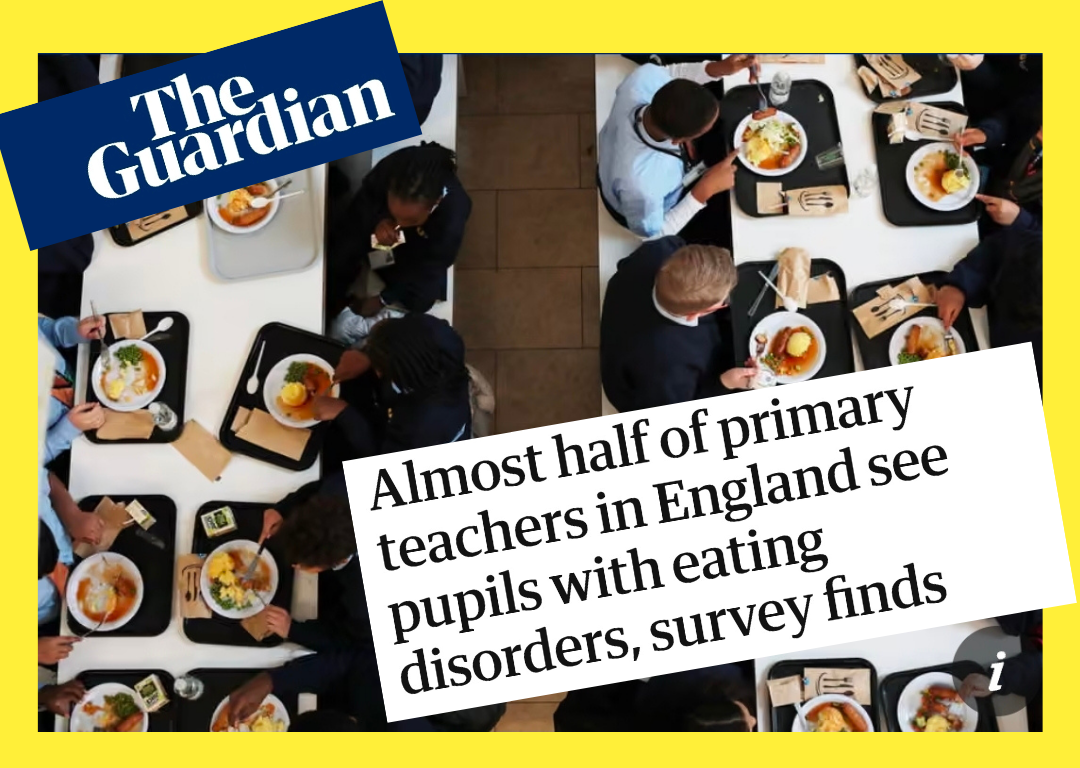
Today, the Guardian reported that almost half of primary school teachers (45%) said they had observed children showing signs of an eating disorder in the past year. The findings, from a National Education Union (NEU) poll of 10,000 teachers in English state schools, showed that figure rises to 78% at secondary level. In special schools and pupil referral units, one in five teachers say they see it regularly.
The same survey found that 48% of teachers regularly witnessed chronic anxiety among pupils, that two-thirds of secondary teachers are regularly encountering absenteeism linked to mental ill-health and that the number of schools with no counsellor at all has risen from 29% to 40% in just three years.
These findings are obviously devastating, but they are not surprising. At the Body Happy Org, we know the extent of the problem - we are currently hearing heart-wrenching stories about how education can shape eating disorders, as part of our research for an Education Round Table being hosted by the All-Party Parliamentary Group on Eating Disorders at Westminster this month. And we are working to tackle the problem.
Eating disorders are a symptom - let’s talk about the cause
Crisis intervention is clearly vital. But eating disorders do not arrive out of nowhere. In many cases, they can develop in children who have learned, often from a very young age, that their body is a problem to be fixed. They emerge from cultures saturated with diet talk, appearance-based judgement, weight stigma and the relentless messaging that some bodies are more valuable than others. They grow in classrooms where food is labelled "good" or "bad", where children are teased about their size, where the adults around them don't always know what to say or do.
Consultant paediatrician Dr Lee Hudson told the Guardian that eating disorders are “going up, but we don’t know why”. Indeed, there is no strong evidence to say why but there is a theory.
“We are living in what may be one of the most fatphobic and body-obsessed cultural moments in living memory,” says Body Happy Org founder Molly Forbes. “The mainstreaming of weight loss drugs, infinite scroll social media, unregulated AI - these things are shaping how children see themselves and their bodies, often before they are old enough to critically evaluate what they're seeing.”
These wider cultural forces do not stay outside the school gate, but trickle into school policy and practice. The way healthy eating is taught. What gets said and rewarded in the school dinner hall. The framing of anti-bullying policies. The language used in PE. We want to be clear, the school environment is not always the direct the cause of an eating disorder.But it may have triggered worsening symptoms, made recovery harder - or, in some cases, planted a seed that grew into disordered eating.
The COVID pandemic added a further, devastating layer. Children and families who were already struggling lost access to services and support almost overnight and waiting lists lengthened dramatically. But during this same period, the government chose to accelerate some of its most aggressive weight-focused public health policies: mandatory calorie labelling on menus and a doubling down on the National Child Measurement Programme, which weighs children in reception and Year 6 and sends letters home about their weight.
“Eating disorders and body shame are not inevitable,” says Molly. “They are not just clinical problems to be managed. They are a signal about the culture we have built around children's bodies and schools have both the power and the responsibility to be part of changing it.”
Teachers are not therapists
One of the most important things this survey tells us is that teachers are on the frontline of a crisis they were never trained for. This is not fair. And it is not sustainable.
Teachers are uniquely placed to notice early warning signs of eating disorders — changes in behaviour, withdrawal, anxiety around food or mealtimes, distress around PE. They often have trusting, long-term relationships with children that no external professional can replicate. But we must be very careful about the burden we place on classroom teachers when it comes to mental health.
The NEU is calling for nurses, mental health leads and quicker access to CAMHS in schools. We wholeheartedly support that call. But alongside that investment in response, we also need investment in prevention. They are not competing priorities. They are both essential.
This is what the Body Happy Schools Programme is built on. It is the UK's first whole-school approach to body respect education, combining CPD for staff, pupil workshops, peer advocacy, and family resources. It is not a one-off assembly. It is a culture change — and we are already seeing what that culture change can do.
None of this replaces clinical support. But it is a powerful, evidence-informed way to reduce the number of children who will ever need it.
Aligned with school priorities
However, when we talk to school leaders, one of the first things we hear is “we're already stretched. We don’t have capacity for another initiative.” But body respect work is not an addition to a school's priorities. It is directly relevant to existing ones.
Body image concerns often show up quietly, in avoidance, disengagement, anxiety and self-criticism, long before they are visible in behaviour, attendance or attainment data. But when schools build a shared understanding of body image and appearance-based stigma, staff feel more confident responding to the issues that come up every day, from playground comments to pastoral concerns. That means fewer reactive incidents to manage, not more.
Body respect also connects directly to what schools are already required to deliver. It sits within RSHE and PSHE, it covers digital literacy, strengthens safeguarding practice, it supports equality and inclusion duties and it reinforces personal development. It’s not about introducing something new, it’s about applying a body respect lens to what schools are already doing, creating coherence across staff teams rather than adding another layer.
So what are we waiting for? Let’s look at prevention now.
